


deckroadmap adds PowerPoint-style roadmap footers to
Quarto and R Markdown Reveal.js slides.
It helps audiences see what has been covered, what section they are
currently in, and what comes next. The package supports multiple
built-in styles, including pill, minimal, and
progress, along with options for colors, size, and
positioning.
 Read the background story
and design notes in the blog post. Documentation:
codingtigertang.github.io/deckroadmap
Read the background story
and design notes in the blog post. Documentation:
codingtigertang.github.io/deckroadmap
Install the stable version from CRAN:
install.packages("deckroadmap")Or install the development version from GitHub:
# install.packages("pak")
pak::pak("CodingTigerTang/deckroadmap")Many business, teaching, and conference presentations use a roadmap
bar to help orient the audience during the talk.
deckroadmap brings that pattern to Reveal.js slides in a
simple R-friendly way.
With one function call, you can add a persistent footer that marks:
The built-in Reveal.js progress bar shows how far you are through the
slide deck. deckroadmap answers a different question: where
are you in the structure of the talk?
deckroadmap currently supports:
It is designed for Reveal.js-based HTML slides.
Add use_roadmap() near the top of your document, then
tag slides with data-roadmap section names. Untagged slides
inherit the most recent section by default.
library(deckroadmap)

use_roadmap(
  c("Intro", "Problem", "Analysis", "Recommendation", "Next Steps"),
  style = "pill"
)
Then use matching section labels on your slides, for example:
## Welcome {data-roadmap="Intro"}

## The problem {data-roadmap="Problem"}

## Analysis overview {data-roadmap="Analysis"}

## Recommendation {data-roadmap="Recommendation"}

## Next steps {data-roadmap="Next Steps"}By default, untagged slides inherit the most recent
data-roadmap value. This makes it easier to tag only the
first slide of each section.
## Intro {data-roadmap="Intro"}

## More intro content

## Problem {data-roadmap="Problem"}

## More problem detail
In this example, the second slide inherits Intro, and the fourth slide inherits Problem.
To hide the roadmap on a specific slide, use:
## Break slide {data-roadmap="none"}This is useful for title slides, divider slides, or transitions where you do not want the roadmap to appear.
Full working examples are included in the examples/
folder:
These show complete Reveal.js slide documents for Quarto and R Markdown.
You can preview a roadmap style locally before rendering slides by
using preview_roadmap().
preview_roadmap(
  sections = c("Intro", "Problem", "Analysis", "Recommendation", "Next Steps"),
  current = "Analysis",
  style = "progress"
)
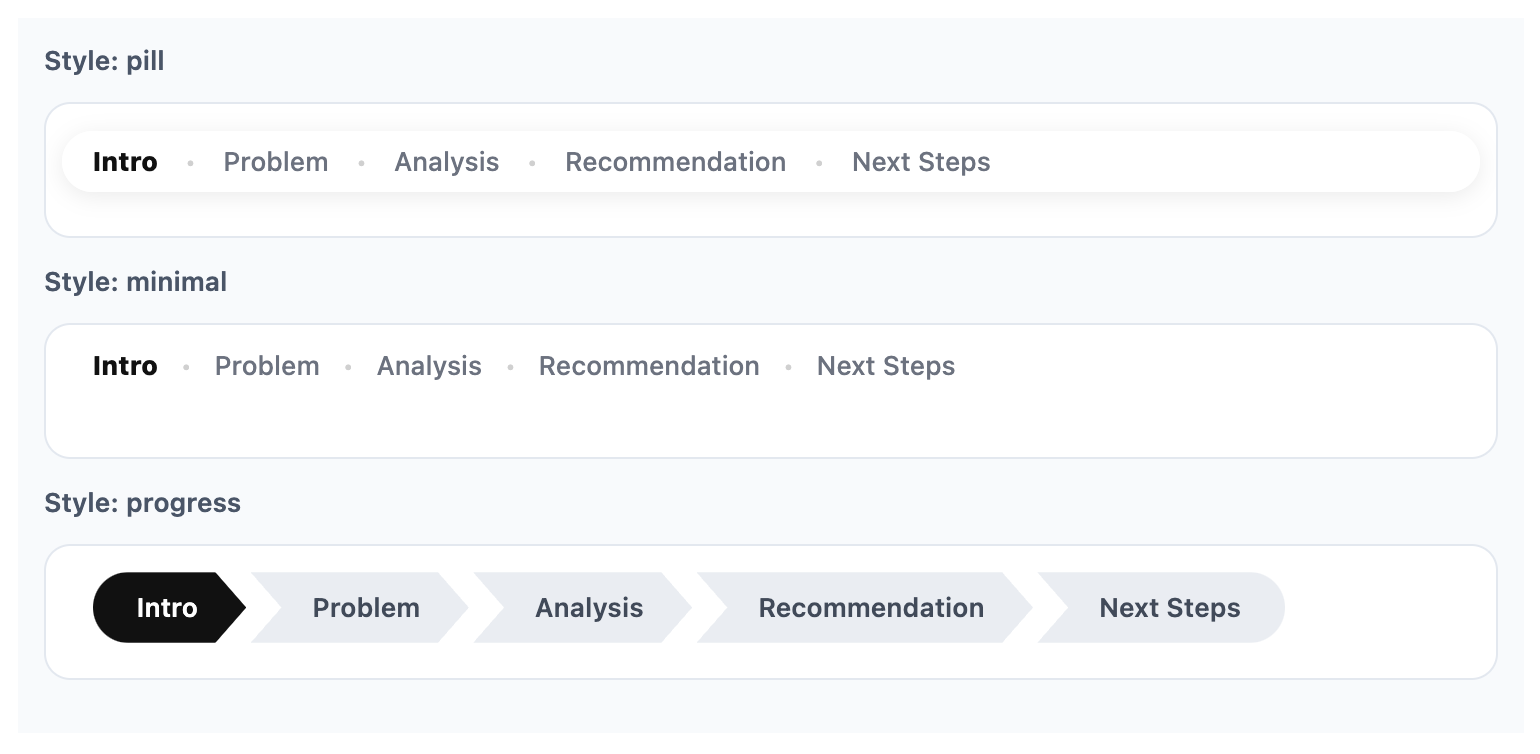
Because this README renders to GitHub Markdown, the live HTML preview is not shown here. The screenshots below were generated locally from the preview function.
deckroadmap currently includes three styles.
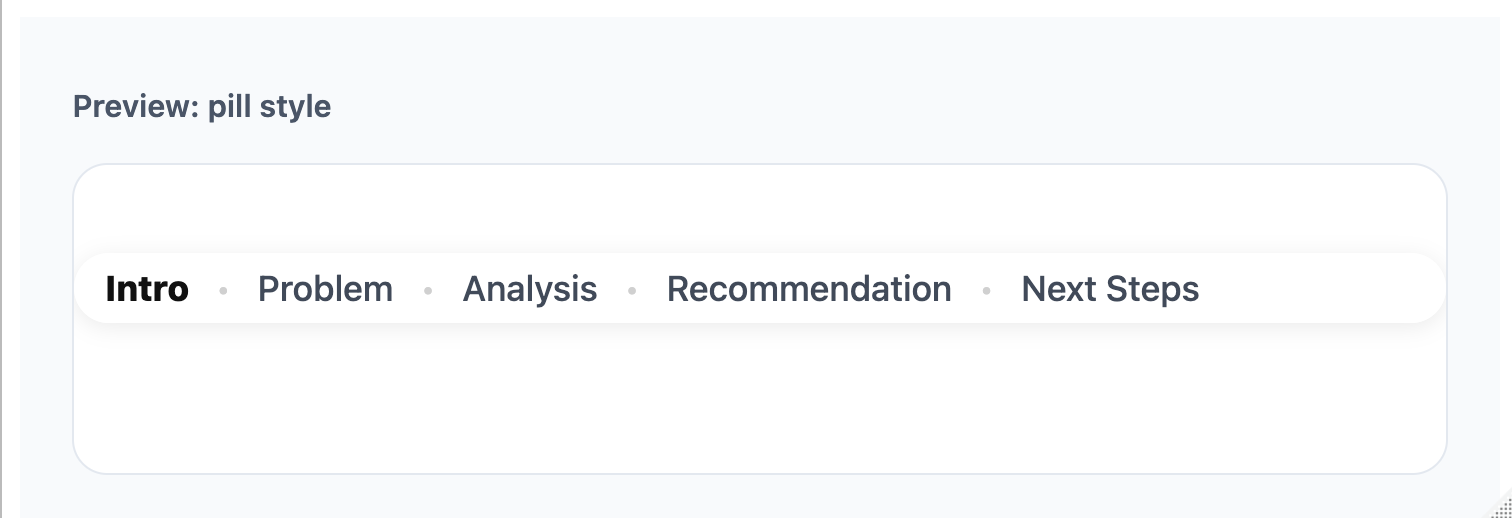
style = "pill"A rounded floating footer with a soft background.
use_roadmap(
  c("Intro", "Problem", "Analysis", "Recommendation", "Next Steps"),
  style = "pill"
)
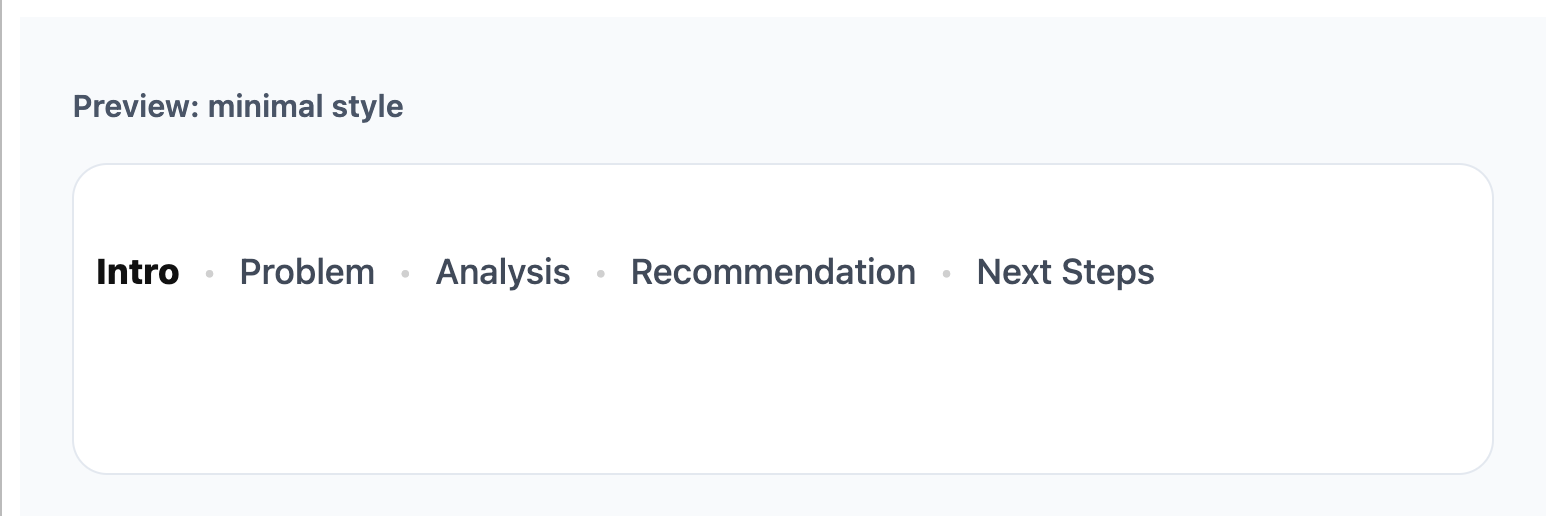
style = "minimal"A lighter text-only roadmap with less visual weight.
use_roadmap(
  c("Intro", "Problem", "Analysis", "Recommendation", "Next Steps"),
  style = "minimal"
)
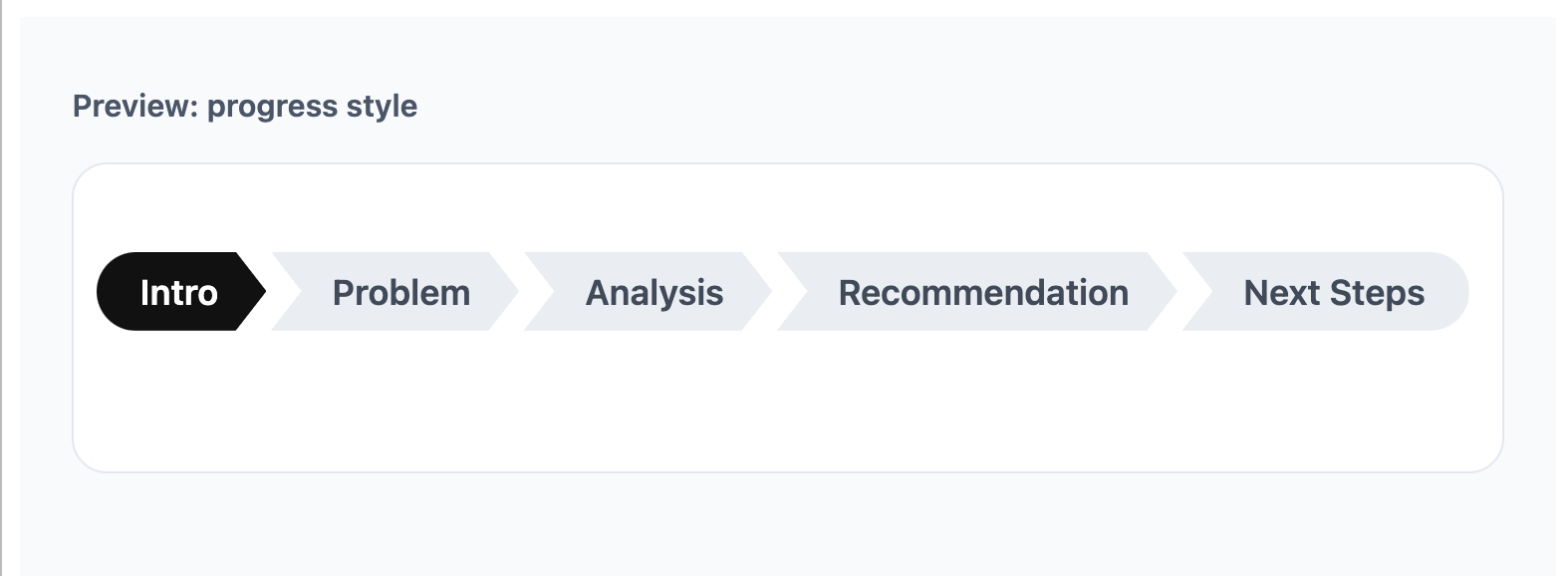
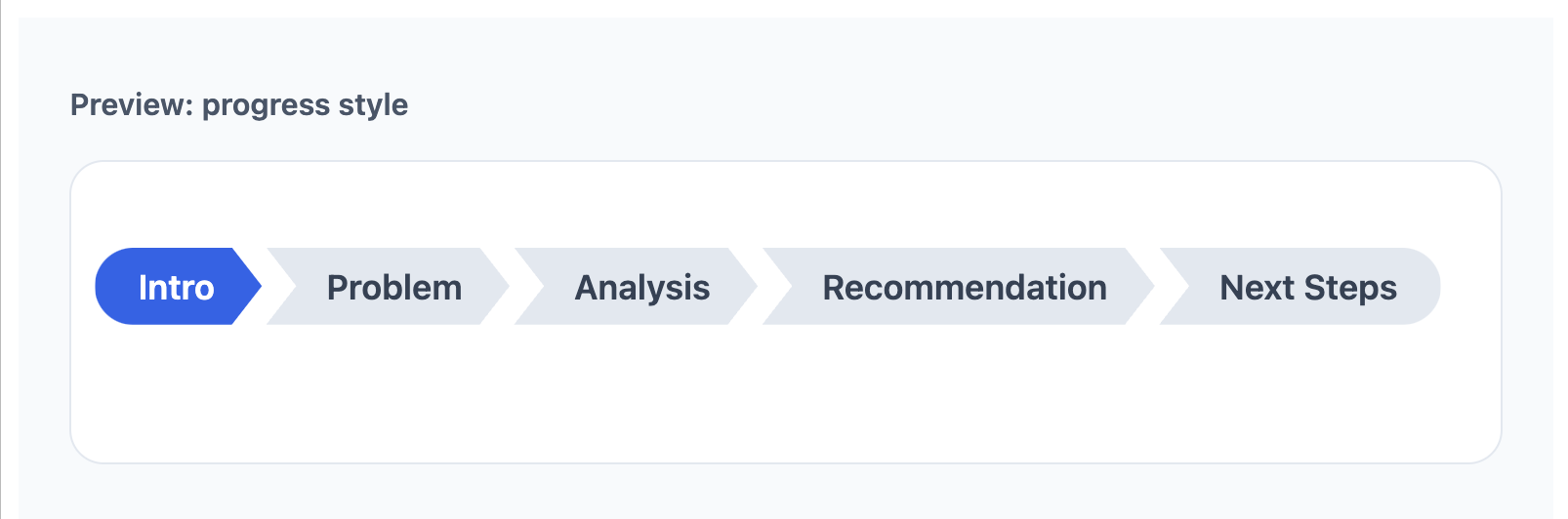
style = "progress"A connected progress-style roadmap with section blocks.
use_roadmap(
  c("Intro", "Problem", "Analysis", "Recommendation", "Next Steps"),
  style = "progress"
)
You can control font size, bottom spacing, text colors, and, for
progress, background colors.
use_roadmap(
  c("Intro", "Problem", "Analysis", "Recommendation", "Next Steps"),
  style = "pill",
  font_size = "14px",
  bottom = "12px",
  active_color = "#2563eb",
  done_color = "#374151",
  todo_color = "#9ca3af"
)
use_roadmap(
  c("Intro", "Problem", "Analysis", "Recommendation", "Next Steps"),
  style = "progress",
  active_color = "#ffffff",
  done_color = "#ffffff",
  todo_color = "#334155",
  active_bg_color = "#2563eb",
  done_bg_color = "#475569",
  todo_bg_color = "#e2e8f0"
)
data-roadmap
values used on slides.data-roadmap="none" to hide the roadmap on a
specific slide.deckroadmap is designed for Reveal.js slide decks, not
PowerPoint output.