


A small, dependable client for S3-compatible object stores (AWS S3, MinIO, Garage, Ceph, …), from R. Nine verbs, one configuration, nothing else to learn:
library(s3pe)

use_endpoint("https://s3.example.org")
use_bucket("my-bucket")

meta <- read_s3("data/manifest.json")     # list, from JSON
sales <- read_s3("series/sales.csv.gz")   # tibble, from gzipped CSV
write_s3(sales, "report/sales.parquet")   # Parquet, by extension
list_s3("data/")read_s3() returns
a tibble for .csv, .csv.gz, .tsv,
.parquet and .xlsx, a list for
.json, an sf object for .geojson, the saved
object for .rds, a string for text and raw bytes for
everything else. write_s3() does the reverse.Content-Length.s3pe_error_not_found,
s3pe_error_access, s3pe_error_http,
s3pe_error_transport, s3pe_error_integrity,
s3pe_error_config, all inheriting from
s3pe_error.options(s3pe.quiet = TRUE).The same package exists for Python, Rust (with a command line) and Go, all in the same repository, with the same verbs and the same behaviour.
# CRAN (once accepted)
install.packages("s3pe")

# Development version
pak::pak("StrategicProjects/s3pe/r")Every request needs an endpoint and a key pair. Put them in
~/.Renviron (R reads it at start-up; never put a secret in
a script or a versioned .Rprofile) and restart R:
S3PE_ENDPOINT=https://s3.example.org
AWS_ACCESS_KEY_ID=...
AWS_SECRET_ACCESS_KEY=...
S3PE_BUCKET=my-bucket
S3PE_BUCKET is optional: it is the bucket used when a
key is not an s3://bucket/key URL and no
bucket argument is given. For one session,
use_endpoint() and use_bucket() do the same.
s3_config() shows what was resolved (the secret is never
printed); see ?s3_config for the full table (endpoint,
region, timeout, retries).
s3_config()
#> <s3pe_config>
#>   endpoint:   https://s3.example.org
#>   region:     us-east-1
#>   bucket:     my-bucket
#>   access_key: AKIA…
#>   secret_key: <set>
#>   timeout:    300 s
#> max_tries: 3| Setting | Option | Environment | Default |
|---|---|---|---|
| endpoint | s3pe.endpoint |
S3PE_ENDPOINT, AWS_ENDPOINT_URL |
required |
| region | s3pe.region |
AWS_REGION, AWS_DEFAULT_REGION |
us-east-1 |
| credentials | AWS_ACCESS_KEY_ID, AWS_SECRET_ACCESS_KEY,
AWS_SESSION_TOKEN |
required | |
| bucket | s3pe.bucket |
S3PE_BUCKET |
none |
| timeout, max_tries | s3pe.timeout, s3pe.max_tries |
300 s, 3 |
Requests are path-style (endpoint/bucket/key), which
every S3-compatible store accepts.
A good publisher writes a manifest last: if
manifest.json is there, everything it lists is there too.
Read it first and use its date as the version of the batch.
library(s3pe)
library(dplyr)

use_bucket("my-bucket")

meta <- read_s3("data/manifest.json")
meta$generated_at

series  <- read_s3("data/series.json")
regions <- read_s3("data/regions.geojson")           # sf, when sf is installed
sales   <- read_s3("series/sales.csv.gz", col_types = "Dncl")

# another bucket on the same store: say so in the key
other <- read_s3("s3://other-bucket/series/prices.csv.gz")

list_s3("series/")
#> # A tibble: 12 × 4
#>    key                      size last_modified       etag
#>    <chr>                   <dbl> <dttm>              <chr>
#>  1 series/sales.csv.gz      2831 2026-10-23 07:01:12 9e10…
#>  …
Writing is the same in reverse:
write_s3(panel, "report/panel.parquet")
#> ↑ s3://my-bucket/report/panel.parquet (12.3 MB, 0.8 s)

write_s3(list(generated_at = Sys.time(), rows = nrow(panel)),
         "report/manifest.json", pretty = TRUE)

upload_s3("output/figure1.png", "report/")           # keeps the file name
download_s3("data/regions.geojson", "data/regions.geojson")

exists_s3("report/panel.parquet")
head_s3("report/panel.parquet")
delete_s3("report/draft.csv")
Pass format = when the extension does not say what you
want (format = "raw" always works), and ... to
reach the reader or writer (col_types,
simplifyVector, pretty, na,
…).
Nothing to do: bodies larger than 64 MiB go up as a multipart upload
(16 MiB parts, one by one, aborted on any failure, every part’s ETag
checked). Both knobs live in
s3_config(multipart_threshold =, part_size =) or in
S3PE_MULTIPART_THRESHOLD and
S3PE_PART_SIZE.
upload_s3("exports/full.parquet", "archive/full.parquet", bucket = "my-bucket")
#> ↑ exports/full.parquet → s3://my-bucket/archive/full.parquet (1.2 GB, 48.3 s)
Uploads also take metadata (user metadata, returned by
head_s3()) and headers (any extra header:
Cache-Control, Content-Disposition,
x-amz-storage-class, server-side encryption):
write_s3(sales, "reports/sales.csv", bucket = "my-bucket",
         metadata = c(author = "ana", run = "2026-10-23"),
         headers = c("Cache-Control" = "max-age=3600"))
head_s3("reports/sales.csv", bucket = "my-bucket")$metadata[[1]]$author
#> [1] "ana"A link anyone can use for a while, without credentials:
presign_s3("reports/report.pdf", bucket = "my-bucket", expires = 3600)
#> "https://s3.example.org/my-bucket/reports/report.pdf?X-Amz-Algorithm=..."
presign_s3("incoming/upload.csv", bucket = "my-bucket", method = "PUT") # accept an uploadcopy_s3("etl/sales.parquet", "archive/sales-2026.parquet", bucket = "my-bucket")
delete_s3(list_s3("tmp/", bucket = "my-bucket")$key, bucket = "my-bucket") # one request
list_s3("series/", bucket = "my-bucket", delimiter = "/") # one level
# mirror a directory to a prefix, by ETag; the manifest goes up last
sync_up_s3("output/", "reports/2026/", bucket = "my-bucket",
delete = TRUE, last = "manifest.json")
#> ✔ sync output/ → s3://my-bucket/reports/2026/: 12 uploaded, 30 unchanged, 0 deleted (3.2 s)
sync_down_s3("s3://my-bucket/reports/2026/", "reports-2026/")Network problems are errors, not warnings: a pipeline that depends on the data should stop. Catch them by class when you want to go on:
meta <- tryCatch(
  read_s3("data/manifest.json"),
  s3pe_error_not_found = function(e) NULL,
  s3pe_error_transport = function(e) { message("offline, using cache"); readRDS("cache.rds") }
)| Class | When |
|---|---|
s3pe_error_config |
no endpoint, no credentials, no bucket |
s3pe_error_not_found |
HTTP 404 (exists_s3() and head_s3() turn
it into FALSE/NULL) |
s3pe_error_access |
HTTP 403 |
s3pe_error_http |
any other HTTP error, with $status and
$code |
s3pe_error_transport |
the server could not be reached, after the retries |
s3pe_error_integrity |
the bytes that arrived are not the bytes that were sent |
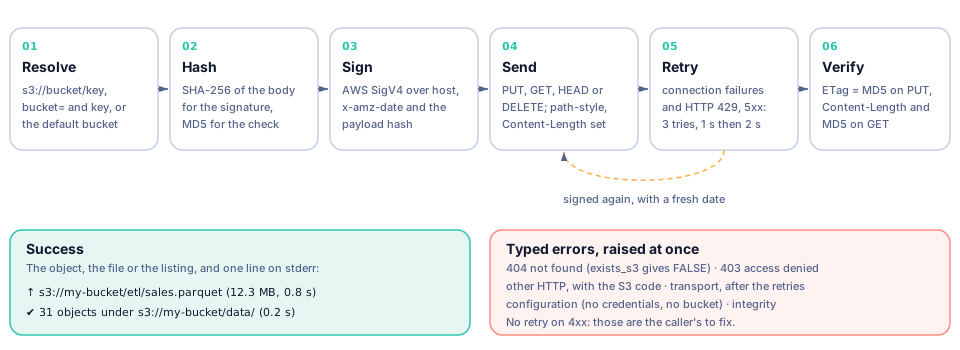

s3pe lê e grava dados em qualquer armazenamento de
objetos compatível com S3 a partir do R: read_s3() e
write_s3() escolhem o formato pela extensão do arquivo
(.csv, .json, .parquet,
.rds, .geojson), upload_s3() e
download_s3() movem arquivos, list_s3(),
head_s3(), exists_s3() e
delete_s3() cuidam do resto. O endpoint e as credenciais
ficam no ~/.Renviron (S3PE_ENDPOINT,
AWS_ACCESS_KEY_ID, AWS_SECRET_ACCESS_KEY),
nunca em scripts. Toda requisição é assinada, repetida em falhas
transitórias e conferida pelo ETag. As mensagens e a documentação estão
em inglês, como nos pacotes irmãos.
s3pe is smaller, picks the format from the extension,
verifies every transfer and never sends the aws-chunked
encoding that some stores reject.s3pe is developed in Recife, Brazil, by the authors listed in
DESCRIPTION.